Mediterranean diet recipes do not need to begin with a list of foods you are forbidden to eat.
They are easier to understand as a way of building meals.
Start with vegetables.
Use beans, lentils, chickpeas, nuts, or seeds regularly.
Choose grains thoughtfully.
Use olive oil and other unsaturated fats.
Include fish and seafood when they fit your preferences.
Add herbs, garlic, onions, tomato, peppers, citrus, and spices for flavor.
Then build a meal that you actually want to eat.
That approach is much closer to the Mediterranean-style eating pattern described by organizations such as the American Heart Association and Harvard T.H. Chan School of Public Health than treating one particular ingredient as a “superfood.” The American Heart Association describes Mediterranean-style eating as emphasizing vegetables, fruits, grains, beans, nuts, seeds, olive oil, fish, and other minimally processed foods, while Harvard describes it as primarily plant-based with whole grains, olive oil, vegetables, fruits, legumes, nuts, herbs, spices, fish, and seafood playing major roles.
That does not mean every Mediterranean restaurant dish is automatically part of the dietary pattern studied in nutrition research.
Restaurant cuisine and a long-term eating pattern are not the same thing.
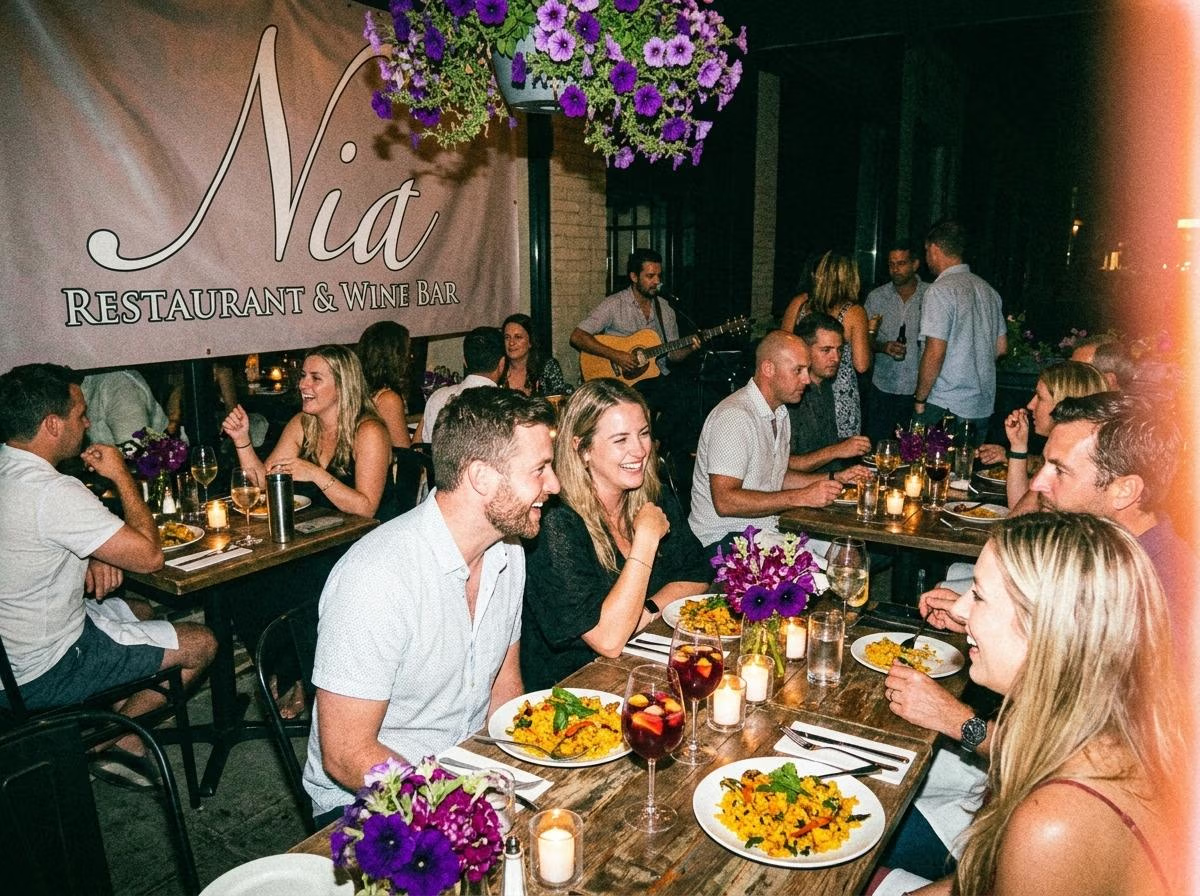
Nia Restaurant & Wine Bar, for example, currently serves a Mediterranean-inspired menu with Spanish roots that includes dishes such as pan-seared salmon with pipérade, shrimp paella, crisp cauliflower with rosemary hummus, gambas al ajillo, salad, olives, patatas bravas, croquetas, pizza, churros, and burnt Basque cheesecake.
Some of those dishes contain ingredients that also appear frequently in Mediterranean-style dietary patterns.
Others are restaurant dishes meant primarily for enjoyment.
For this page, the useful opportunity is not to label the entire Nia menu “healthy.”
It is to take culinary ideas from Mediterranean cooking and translate them into practical home recipes built around vegetables, seafood, legumes, grains, olive oil, herbs, citrus, and other recognizable ingredients.
The recipes below are therefore Nia-inspired rather than copied from Nia’s kitchen.
They use some of the same flavor relationships you may encounter at the restaurant while giving home cooks enough detail to prepare their own versions.
First, What Makes a Recipe “Mediterranean Diet–Inspired”?

There is no single official Mediterranean diet recipe book.
Harvard describes the Mediterranean diet as an eating pattern rather than a strictly regimented meal plan. Different Mediterranean countries have different traditional diets, but recurring features include vegetables, fruits, beans and other legumes, whole grains, nuts, olive oil, herbs and spices, with fish and seafood commonly used as animal proteins.
The American Heart Association similarly emphasizes vegetables, fruits, whole grains, beans, legumes, nuts, plant-based proteins, fish and seafood, and unsaturated plant oils within a healthy overall dietary pattern. Its current guidance also stresses that the quality of the entire eating pattern matters more than one supposedly special food.
That gives us a practical recipe framework.
A Mediterranean diet-inspired recipe often works well when it contains several of the following:
- vegetables;
- beans, lentils, or chickpeas;
- whole or minimally refined grains;
- fish or seafood;
- nuts or seeds;
- olive oil;
- herbs;
- garlic and onions;
- tomatoes or peppers;
- citrus;
- and moderate portions of dairy, poultry, or other animal foods according to preference.
Not every dish needs every category.
A meal becomes more balanced across the whole day and overall pattern, not because every plate contains twelve different “healthy” ingredients.
Recipe 1: Saffron Shrimp and Vegetable Rice
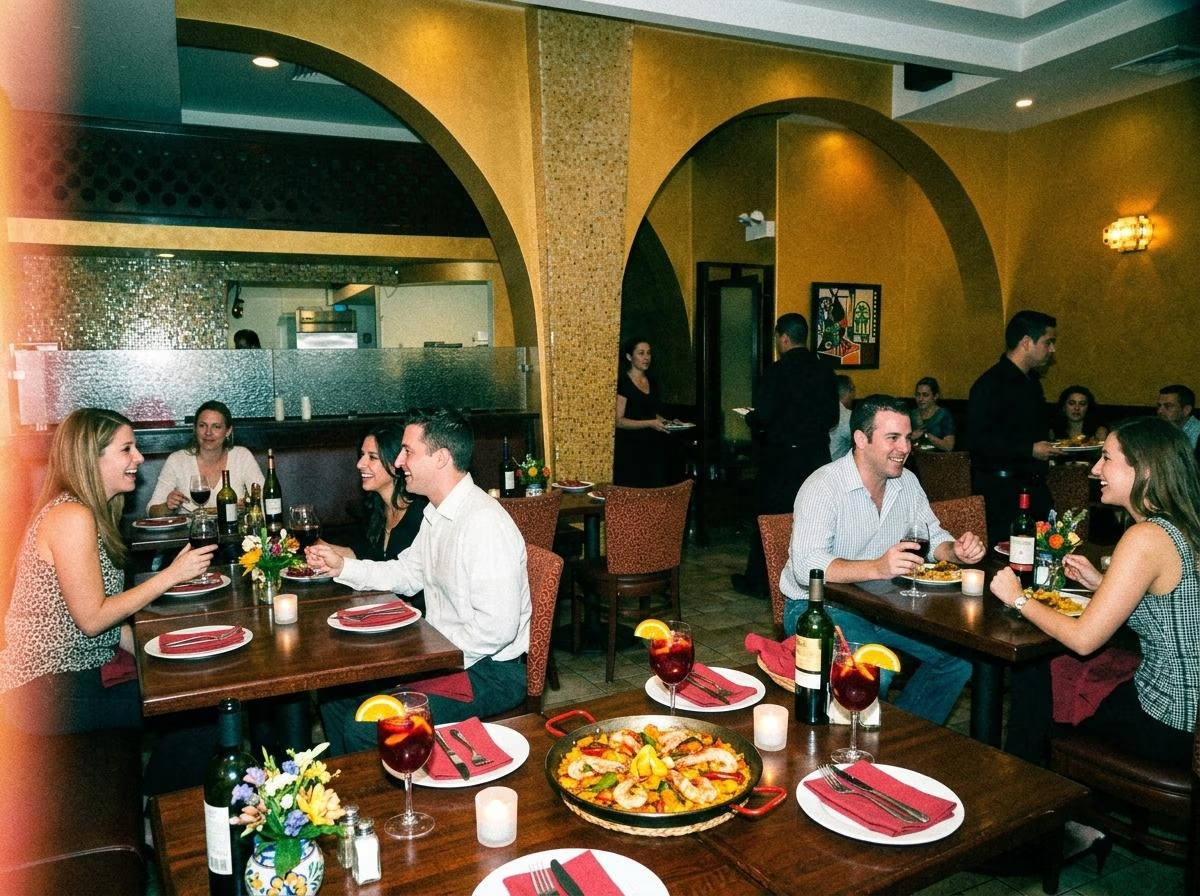
This first recipe takes inspiration from Nia’s current shrimp paella without attempting to reproduce the restaurant’s proprietary preparation.
Nia currently lists its dish as saffron rice with shrimp, peas, peppers, parsley, extra-virgin olive oil, and lemon.
For a home recipe aligned more closely with Mediterranean-style meal building, the emphasis remains on shrimp, vegetables, olive oil, herbs, and rice.
Serves
4
Ingredients
- 1½ cups short-grain rice
- 1 pound peeled and deveined shrimp
- 2 tablespoons extra-virgin olive oil, divided
- 1 medium onion, finely chopped
- 1 red bell pepper, diced
- 1 yellow or orange bell pepper, diced
- 3 garlic cloves, minced
- 1 cup chopped or crushed tomatoes
- ½ teaspoon smoked paprika
- A generous pinch of saffron threads
- 3½ cups low-sodium seafood or vegetable stock, warmed
- 1 cup frozen peas
- ½ cup chopped fresh parsley
- 1 lemon
- Freshly ground black pepper
- Salt, used lightly and adjusted to taste
Method
Warm the stock and add the saffron. Allow it to sit for several minutes so the saffron begins infusing the liquid.
Heat one tablespoon of olive oil in a wide skillet or paella-style pan over medium heat.
Add the onion and peppers and cook until they begin to soften.
Add the garlic and paprika and cook briefly, taking care not to burn the garlic.
Stir in the tomatoes and cook until the mixture becomes slightly more concentrated.
Add the rice and stir briefly so the grains become coated with the tomato, aromatics, and oil.
Pour in the warm saffron stock.
Bring the mixture to a gentle simmer.
Once the rice has begun cooking evenly, reduce unnecessary stirring. You are building a rice dish rather than a risotto.
After the rice has cooked for roughly 12 minutes, add the peas and arrange the shrimp over the rice.
Continue cooking until the shrimp is opaque and the rice is tender but still retains structure.
Depending on the pan, rice variety, and heat, you may need slightly more hot stock.
Remove from the heat and allow the rice to rest briefly.
Finish with the remaining olive oil, parsley, black pepper, and lemon juice.
Serve with additional lemon wedges.
Why This Version Works
The dish combines seafood, vegetables, tomato, olive oil, herbs, and rice in one pan.
The shrimp provides protein.
Peppers, peas, tomato, onion, and parsley add plant variety.
Lemon adds acidity so the dish does not depend entirely on salt for flavor.
Olive oil contributes richness.
For readers who want a stronger whole-grain emphasis, brown rice can be used, but the cooking liquid and timing need significant adjustment.
Important Paella Note
This is a paella-inspired home rice dish, not a claim to traditional paella Valenciana.
Traditional Valencian paella has a distinct history and ingredient framework.
Nia’s dedicated Best Paella in Chicago guide should remain the deeper page for paella history, Valencian tradition, socarrat, rice selection, and Chicago restaurant comparisons.
This recipe page should stay focused on practical home cooking.
Recipe 2: Pan-Seared Salmon With Quick Pipérade
Nia’s current menu serves pan-seared salmon with pipérade, described as a warm medley of peppers, onions, and tomato.
That combination translates extremely well into a home recipe because the vegetable component can be prepared in advance.
Serves
Ingredients
- 4 salmon fillets, approximately 4–5 ounces each
- 1 tablespoon extra-virgin olive oil for the salmon
- 1 tablespoon extra-virgin olive oil for the vegetables
- 1 red bell pepper, thinly sliced
- 1 yellow bell pepper, thinly sliced
- 1 medium onion, thinly sliced
- 2 garlic cloves, minced
- 2 medium tomatoes, chopped, or 1½ cups no-salt-added canned tomatoes
- 1 teaspoon paprika
- ½ teaspoon dried thyme or several fresh thyme sprigs
- Black pepper
- A small amount of salt
- 1 tablespoon chopped parsley
- 1 lemon
Make the Pipérade
Heat one tablespoon olive oil in a skillet over medium heat.
Add the onion and peppers.
Cook slowly until softened.
Add the garlic and paprika and cook briefly.
Add the tomatoes and thyme.
Reduce the heat and let the vegetables simmer until the tomato has broken down and the peppers are tender but still recognizable.
Season lightly with salt and black pepper.
Finish with parsley.
Cook the Salmon
Pat the salmon dry.
Season lightly with pepper and a small amount of salt.
Heat one tablespoon olive oil in a clean skillet over medium-high heat.
Place the salmon in the pan and cook until well browned on the first side.
Turn carefully and finish cooking until the center reaches your preferred doneness and food-safety standard.
Serve each piece over or beside the warm pipérade.
Finish with lemon.
Make It More Plant-Forward
Serve the salmon with a generous portion of pipérade and another vegetable side rather than making the fish the only substantial component.
For example:
- roasted broccoli;
- green beans;
- a white-bean salad;
- or a small serving of whole-grain farro.
This approach mirrors the broader guidance from Harvard and the American Heart Association to build meals around vegetables, whole grains, beans and legumes, and quality protein sources rather than automatically centering the plate around a very large portion of meat.
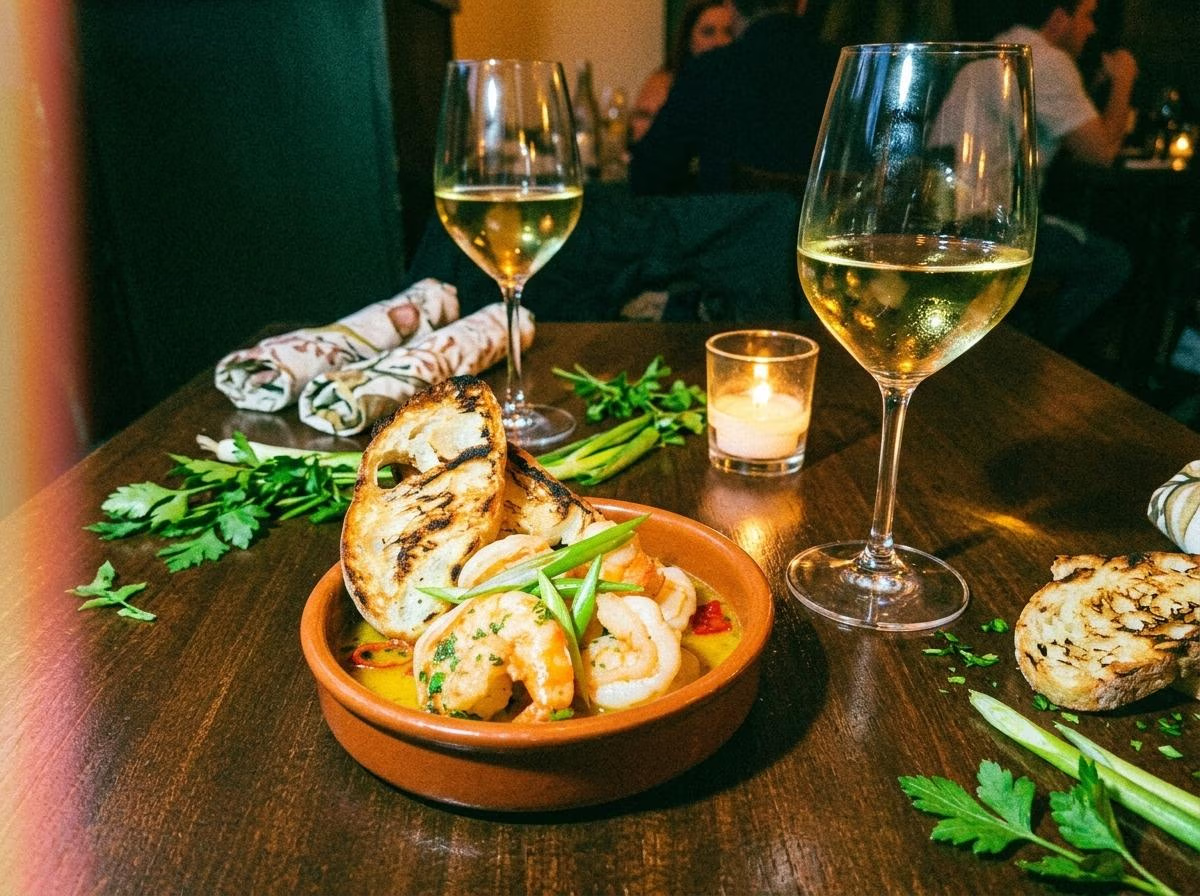
Recipe 3: Garlic-Lemon Shrimp With Olive Oil and Chili
Nia’s current gambas al ajillo uses shrimp sautéed in garlic-infused olive oil with Spanish chili and white wine, served with crusty bread.
This home version keeps the garlic-shrimp idea while increasing lemon and herbs and making the wine optional.
Serves
4 as a shared starter or 2 as a main component
Ingredients
- 1 pound large shrimp, peeled and deveined
- 2 tablespoons extra-virgin olive oil
- 5 garlic cloves, thinly sliced
- ¼ teaspoon red-pepper flakes, or more according to preference
- ¼ cup dry white wine or low-sodium vegetable stock
- Juice of ½ lemon
- Zest of ½ lemon
- ¼ cup chopped parsley
- Freshly ground black pepper
- A small amount of salt
- Optional whole-grain bread for serving
Method
Pat the shrimp dry.
Warm the olive oil over medium heat.
Add the sliced garlic and cook gently until aromatic but not dark brown.
Add the chili flakes.
Increase the heat slightly and add the shrimp.
Cook briefly on one side.
Turn the shrimp and add the wine or stock.
Allow the liquid to simmer until the shrimp is cooked through.
Remove from the heat.
Add lemon juice, zest, parsley, and black pepper.
Taste before adding additional salt.
Serve immediately.
Turn It Into a Complete Meal
The restaurant version naturally works as a shared small plate.
At home, you can build it into a broader meal by adding:
- a large tomato-and-cucumber salad;
- white beans with herbs;
- roasted vegetables;
- or a small portion of whole-grain bread.
That creates a more complete Mediterranean-style meal without requiring another animal protein.
Recipe 4: Roasted Cauliflower With Rosemary Chickpea Hummus
Nia currently serves crisp cauliflower with rosemary hummus, chili oil, and pita.
This home adaptation increases the chickpea component and uses roasted rather than deep-fried cauliflower.
Serves
For the Cauliflower
- 1 large head cauliflower, cut into florets
- 1½ tablespoons olive oil
- ½ teaspoon smoked paprika
- ¼ teaspoon black pepper
- A small amount of salt
For the Rosemary Hummus
- 1 can chickpeas, drained and rinsed
- 2 tablespoons tahini
- 2 tablespoons extra-virgin olive oil
- Juice of 1 lemon
- 1 small garlic clove
- ½ teaspoon finely chopped fresh rosemary
- 2–4 tablespoons cold water
- Black pepper
- Optional pinch of salt
Optional Chili Finish
- 1 teaspoon olive oil
- A pinch of chili flakes
Method
Heat the oven to 425°F.
Toss the cauliflower with olive oil, smoked paprika, black pepper, and a small amount of salt.
Spread it across a baking sheet without overcrowding.
Roast until deeply browned at the edges and tender.
Meanwhile, add the chickpeas, tahini, olive oil, lemon, garlic, rosemary, and black pepper to a blender or food processor.
Blend while adding cold water gradually until the hummus reaches your preferred texture.
Spread the hummus across a plate or shallow bowl.
Top with the roasted cauliflower.
If desired, combine a teaspoon of olive oil with chili flakes and drizzle a small amount over the top.
Serve with vegetable sticks, whole-grain pita, or as part of a larger shared dinner.
Why Chickpeas Matter
Legumes such as chickpeas, beans, lentils, and peas provide plant protein and fiber and are recurring foods within Mediterranean-style dietary patterns. Harvard identifies legumes as inexpensive sources of protein, complex carbohydrates, vitamins, and fiber.
That is enough nutrition context.
There is no need to claim that hummus “detoxes,” “fights inflammation,” or prevents a specific disease.
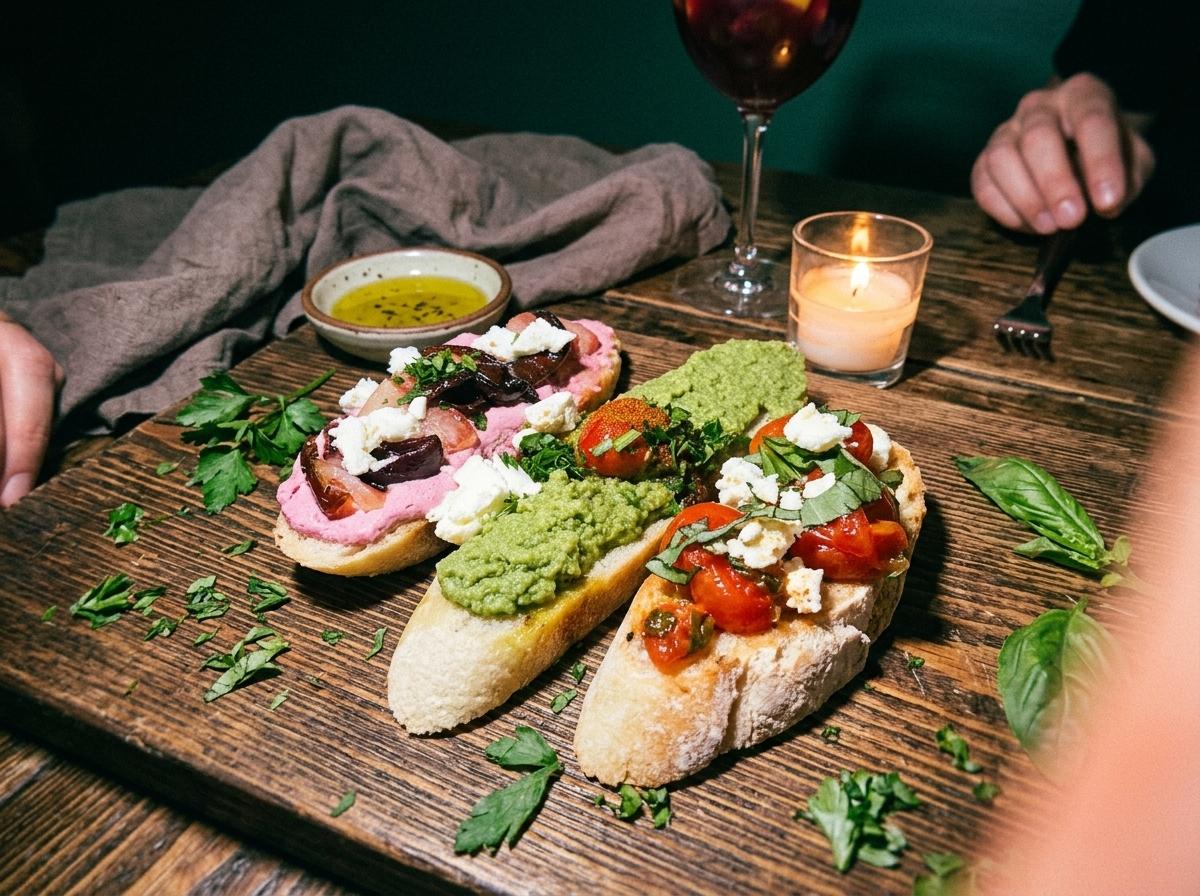
Recipe 5: Tomato, Basil, and Feta Sourdough Crostini
Nia’s current crostini menu includes a pan-con-tomate-inspired version using tomato jam, basil, and feta.
Traditional pan con tomate is its own Spanish preparation, so this home recipe should be described accurately as tomato-basil crostini, not as a claim to an authentic Catalan recipe.
Serves
4
Ingredients
- 8 small slices sourdough or whole-grain country bread
- 4 ripe tomatoes
- 1 tablespoon extra-virgin olive oil
- 1 small garlic clove
- ¼ cup fresh basil
- ⅓ cup crumbled feta
- Black pepper
- Optional splash of red-wine vinegar
Method
Toast the bread until crisp around the edges.
Grate or finely chop the tomatoes.
If very watery, allow some of the excess liquid to drain.
Rub the toasted bread lightly with garlic.
Combine the tomatoes with olive oil, black pepper, basil, and a very small splash of vinegar if additional acidity is needed.
Spoon the tomato mixture onto the bread just before serving.
Top with a small amount of feta.
Make It a Lunch
Pair two crostini with:
- a large leafy salad;
- white beans;
- cucumber;
- peppers;
- and a lemon-olive-oil dressing.
That transforms a starter idea into a more complete plant-forward lunch.
Recipe 6: White Bean, Tomato, Cucumber, and Herb Salad
Not every recipe on this page needs to copy a restaurant menu item.
In fact, the page becomes more useful when it expands beyond restaurant dishes and shows how the Mediterranean eating pattern can work at home.
Beans are a particularly practical place to start.
Serves
4
Ingredients
- 2 cans no-salt-added or low-sodium white beans, drained and rinsed
- 2 cups cherry tomatoes, halved
- 1 cucumber, diced
- 1 red or yellow bell pepper, diced
- ¼ small red onion, finely sliced
- ¼ cup chopped parsley
- 2 tablespoons chopped mint or basil
- 2 tablespoons extra-virgin olive oil
- Juice of 1 lemon
- 1 tablespoon red-wine vinegar
- Black pepper
- Optional ⅓ cup crumbled feta
Method
Combine the beans, tomatoes, cucumber, bell pepper, onion, parsley, and herbs in a large bowl.
Whisk together olive oil, lemon juice, vinegar, and black pepper.
Pour over the salad and toss.
Allow the mixture to sit for 10 minutes before serving so the beans absorb some of the dressing.
Add feta only if desired.
Why This Is a Useful Mediterranean Diet Recipe
It is practical.
There is no complicated technique.
The ingredients are widely available.
Beans provide plant protein and fiber.
Vegetables make up most of the volume.
Olive oil provides an unsaturated fat source.
Lemon, herbs, onion, and vinegar create flavor without requiring a heavy sauce.
This is closer to how Mediterranean-style eating becomes sustainable in everyday life: not through elaborate “superfood” recipes, but through repeatable meals that taste good.
Recipe 7: Mediterranean Grain Bowl With Chickpeas and Roasted Vegetables
Grain bowls are not a traditional universal Mediterranean dish.
They are a modern format that can be used to apply Mediterranean-style ingredients conveniently.
That distinction should be clear.
Serves
4
Ingredients
- 2 cups cooked farro, barley, bulgur, or brown rice
- 1 can chickpeas, drained and rinsed
- 1 zucchini, chopped
- 1 bell pepper, chopped
- 1 small eggplant, chopped
- 1 red onion, chopped
- 2 tablespoons olive oil, divided
- 2 cups mixed greens
- ¼ cup chopped parsley
- 2 tablespoons toasted almonds or walnuts
- Juice of 1 lemon
- 1 teaspoon Dijon mustard
- Black pepper
- Optional feta or plain yogurt
Method
Heat the oven to 425°F.
Spread the zucchini, pepper, eggplant, and onion across a baking sheet.
Toss with one tablespoon olive oil and black pepper.
Roast until the vegetables are tender and browned.
Warm the chickpeas if desired.
Whisk the remaining olive oil with lemon juice, mustard, and black pepper.
Divide the grain among bowls.
Add greens, roasted vegetables, chickpeas, parsley, and nuts.
Drizzle with the lemon dressing.
Add a small amount of feta or plain yogurt if desired.
Whole-Grain Note
Harvard’s Healthy Eating Plate recommends choosing whole grains such as barley, brown rice, quinoa, and whole-grain products rather than relying primarily on refined grains.
That does not mean white rice or bread must disappear from Mediterranean cuisine.
It means home cooks trying to align a meal more closely with a Mediterranean-style dietary pattern can choose whole grains more often.
Recipe 8: Lemon-Herb Fish With Tomatoes and Olives
The old version of this Nia page centered heavily on branzino.
Branzino is no longer on the current Nia dinner menu reviewed for this rewrite.
Instead of pretending otherwise, this page can preserve the useful cooking idea through a flexible white-fish recipe that home cooks can prepare with an available fish.
Serves
4
Ingredients
- 4 white-fish fillets such as cod, sea bass, haddock, or another suitable firm fish
- 1½ tablespoons olive oil
- 2 cups cherry tomatoes
- ½ cup pitted olives, halved
- 2 garlic cloves, thinly sliced
- Juice and zest of 1 lemon
- 1 teaspoon dried oregano
- 2 tablespoons chopped parsley
- Black pepper
- A small amount of salt
Method
Heat the oven to 400°F.
Place the tomatoes, olives, garlic, half the olive oil, oregano, and black pepper in a baking dish.
Roast for approximately 10 minutes.
Pat the fish dry.
Place the fish over the tomato mixture.
Drizzle with the remaining oil and lemon juice.
Return to the oven and roast until the fish is opaque and flakes easily.
Finish with lemon zest and parsley.
Why This Replaces the Branzino Section
The old article claims a current Nia branzino prepared with ladolemono.
Keeping that as a restaurant claim would be inaccurate today.
A flexible white-fish recipe lets the page retain Mediterranean fish-cooking relevance without misleading readers about Nia’s live menu.
If branzino returns later, the current menu can be linked or the example refreshed.
Recipe 9: Nia-Inspired Greens With Dates, Peppers, and Almonds
Nia’s current salad combines mixed greens, goat cheese, avocado, dates, piquillo peppers, candied almonds, and champagne vinaigrette.
This home adaptation retains the sweet-savory contrast but reduces the number of rich additions.
Serves
4
Ingredients
- 6 cups mixed greens
- 1 red bell pepper or several jarred roasted peppers, sliced
- 4 dates, finely chopped
- ¼ cup toasted unsalted almonds
- ¼ cup crumbled goat cheese, optional
- ½ cucumber, chopped
Dressing
- 1½ tablespoons olive oil
- 1 tablespoon champagne or white-wine vinegar
- 1 teaspoon Dijon mustard
- 1 teaspoon lemon juice
- Black pepper
Method
Place the greens, peppers, dates, almonds, cucumber, and optional cheese in a large bowl.
Whisk together olive oil, vinegar, mustard, lemon, and black pepper.
Dress lightly just before serving.
The Useful Lesson From This Salad
Mediterranean-style eating is not synonymous with plain lettuce and grilled chicken.
Sweet fruit, nuts, vegetables, herbs, cheese, vinegar, and olive oil can create contrast.
The important thing is the overall construction of the meal.
Recipe 10: Quick Tomato-Lentil Skillet With Herbs
Legumes deserve more representation on a page targeting Mediterranean diet recipes.
The current Nia menu is restaurant-oriented and therefore does not necessarily reflect the proportion of beans and lentils found in many Mediterranean-style eating patterns.
This recipe helps close that gap.
Serves
4
Ingredients
- 2 cups cooked lentils
- 1 tablespoon olive oil
- 1 small onion, diced
- 2 garlic cloves, minced
- 1 red bell pepper, diced
- 1 can no-salt-added diced tomatoes
- 1 teaspoon smoked paprika
- ½ teaspoon cumin
- 2 cups spinach
- ¼ cup chopped parsley
- Juice of ½ lemon
- Black pepper
- Optional plain yogurt for serving
Method
Heat olive oil in a skillet.
Cook onion and pepper until softened.
Add garlic, paprika, and cumin.
Stir briefly.
Add tomatoes and lentils.
Simmer until the sauce thickens and the lentils are heated through.
Fold in spinach until wilted.
Finish with lemon, parsley, and black pepper.
Serve on its own or with a small portion of whole grain.
Why This Recipe Belongs Here
A recipe page focused only on paella, fish, and olive oil would still provide a distorted picture of Mediterranean-style eating.
Harvard and the American Heart Association both emphasize beans and other legumes as recurring elements within the overall pattern.
This recipe brings that part of the pattern into the article without competing with Nia’s ingredient guide.
How to Build Your Own Mediterranean Diet–Inspired Recipe
Once you understand the pattern, you do not need a formal recipe every night.
Use a simple framework.
Step 1: Choose a Vegetable Base
Start with two or more vegetables.
For example:
- tomatoes and peppers;
- cauliflower and greens;
- eggplant and zucchini;
- cucumber and tomato;
- mushrooms and spinach.
Variety matters more than trying to identify the single “healthiest” vegetable.
Step 2: Add a Protein
Options might include:
- beans;
- lentils;
- chickpeas;
- fish;
- shrimp;
- chicken;
- eggs;
- or a moderate amount of yogurt or cheese.
Plant proteins can play a much larger role than many meat-centered restaurant meals suggest.
Step 3: Add a Grain if the Meal Needs One
Try:
- farro;
- barley;
- bulgur;
- brown rice;
- whole-grain bread;
- or another grain appropriate to the dish.
Traditional cuisine does not need to be rewritten as a grain bowl, but whole grains can be useful for everyday home meals.
Step 4: Use an Unsaturated Fat Source
Olive oil is the most obvious Mediterranean example.
Nuts and seeds also contribute unsaturated fats.
The American Heart Association recommends non-tropical liquid plant oils such as olive oil in place of fats higher in saturated fat within an overall healthy dietary pattern.
That does not mean unlimited olive oil makes a meal healthier.
Oil remains energy-dense and should serve a culinary purpose.
Step 5: Build Flavor With Acidity
Use:
- lemon;
- vinegar;
- tomato;
- or another acidic ingredient.
Acid can brighten vegetables, seafood, beans, and grains while reducing the need to rely exclusively on salt for impact.
Step 6: Add Aromatics
- Garlic.
- Onion.
- Parsley.
- Basil.
- Rosemary.
- Mint.
- Oregano.
- Paprika.
- Cumin.
- Saffron.
- Chili.
Use the ingredients appropriate to the regional direction of the dish rather than mixing every “Mediterranean” seasoning into one pan.
Five Easy Meal Formulas
If you do not want to follow a recipe, these formulas can simplify meal planning.
Formula 1: Fish + Two Vegetables + Whole Grain
Example:
- salmon;
- pipérade;
- green beans;
- farro.
Formula 2: Legume + Grain + Vegetables + Lemon Dressing
Example:
- chickpeas;
- bulgur;
- tomatoes;
- cucumber;
- peppers;
- parsley;
- olive oil and lemon.
Formula 3: Roasted Vegetables + Hummus + Whole-Grain Bread
Example:
- cauliflower;
- zucchini;
- peppers;
- rosemary hummus;
- whole-grain pita.
Formula 4: Seafood + Tomato + Garlic + Greens
Example:
- shrimp;
- tomato;
- garlic;
- spinach;
- parsley;
- small portion of rice.
Formula 5: Bean Salad + Bread + Fruit
Example:
- white beans;
- tomato;
- cucumber;
- herbs;
- olive oil;
- whole-grain bread;
- fresh fruit.
Simple formulas can make Mediterranean-style home cooking much easier than trying to recreate restaurant food every night.
Mediterranean Diet Recipes Do Not Need to Be Low-Fat
One of the most persistent nutrition misconceptions is that a “healthy” recipe should contain as little fat as possible.
Mediterranean-style eating does not work that way.
Olive oil, nuts, seeds, and fish can all contribute unsaturated fats.
The American Heart Association’s current guidance recommends replacing sources of saturated fat with unsaturated-fat sources rather than treating all dietary fat as equivalent.
The more useful question is therefore:
What kind of fat is being used, how much is needed for the recipe, and what else is in the meal?
A tablespoon of olive oil used to roast vegetables has a clear culinary function.
Pouring a very large quantity over every dish because olive oil has a healthy reputation does not automatically improve the overall diet.
Mediterranean Diet Recipes Do Not Need to Be Low-Carbohydrate
Mediterranean-style eating includes grains, bread, beans, fruits, and other carbohydrate-containing foods.
The stronger distinction is often between:
- whole versus highly refined grains;
- fiber-rich versus low-fiber foods;
- and the quality of the meal as a whole.
Harvard’s Healthy Eating Plate specifically recommends whole grains such as barley, brown rice, oats, and other intact grains while limiting reliance on refined grains.
That does not mean paella is forbidden because it uses white rice.
It means everyday home meals can include a wider range of whole-grain options.
You Do Not Need to Eat Fish Every Day
Fish and seafood are important components of many Mediterranean-style dietary patterns, but the pattern is also strongly plant-based.
- Beans.
- Lentils.
- Chickpeas.
- Nuts.
- Seeds.
- Vegetables.
- Whole grains.
These foods deserve just as much space on a Mediterranean diet recipe page as salmon and shrimp.
A home cook who does not eat seafood can still build Mediterranean-style meals around legumes, grains, vegetables, olive oil, nuts, and herbs.
You Do Not Need Wine
The current Nia recipe page repeatedly adds wine and sangria recommendations to food sections.
That should not be the default framing for a Mediterranean diet recipe page.
Alcohol is optional.
The American Heart Association’s current dietary guidance says that people who do not drink alcohol should not start, and people who do drink should limit intake.
Recipes should therefore stand on their own.
Readers who want wine pairings can move to Nia’s dedicated Mediterranean Wine Pairing guide.
How to Use Olive Oil Without Making Every Dish Taste the Same
Olive oil appears repeatedly in Mediterranean-style recipes, but it should not become the only flavor.
Use it differently depending on the dish.
For roasted vegetables, olive oil can support browning.
For hummus, it can contribute richness.
For salad dressing, combine it with lemon or vinegar.
For seafood, it can carry garlic and chili.
For bread, a small drizzle may be enough.
For grain bowls, use it as part of the dressing rather than pouring it over everything separately.
The Mediterranean Ingredient Guide should remain the deeper resource for olive oil itself.
This recipe page should focus on application.
Can Mediterranean Recipes Be Made Quickly?
Yes.
Not every Mediterranean-style recipe requires slow cooking.
A white-bean salad can be made in approximately 15 minutes.
Garlic shrimp cooks quickly.
A grain bowl can use pre-cooked whole grains.
Canned chickpeas remove soaking time.
Frozen vegetables can make weeknight cooking easier.
Harvard’s recipe resources similarly encourage practical use of vegetables, whole grains, fish, beans, nuts, and quality oils rather than requiring every meal to be elaborate.
Mediterranean-style cooking becomes more sustainable when recipes are realistic enough to repeat.
Are Canned Beans Acceptable?
Yes.
Canned chickpeas, lentils, and beans can make home cooking dramatically easier.
Choose lower-sodium or no-salt-added varieties when practical and rinse them before use.
A food does not stop fitting a Mediterranean-inspired meal simply because someone did not soak beans overnight.
Convenience and good nutrition do not need to be opposites.
Can Frozen Vegetables Work?
Yes.
“Fresh” should not be treated as a moral category.
Frozen vegetables can be useful for:
- peas;
- spinach;
- artichokes;
- green beans;
- and other ingredients.
A realistic home-cooking resource should help readers eat well with the tools available to them rather than pretending everyone shops at an outdoor Mediterranean market every morning.
Does Every Recipe Need to Be Traditional?
No.
This is particularly important for this page.
There are two different types of content:
traditional regional recipes
and
Mediterranean diet-inspired recipes.
They are not automatically the same.
A traditional paella has cultural rules and history.
A chickpea grain bowl may use Mediterranean-style ingredients without being a historical Mediterranean dish.
Both can belong on a home-cooking site if they are labeled accurately.
Nia itself describes its concept as Mediterranean-inspired with Spanish roots rather than claiming that every dish reproduces one historical regional recipe.
The same honesty should apply here.
“Nia-Inspired” Should Not Mean “Nia’s Exact Recipe”
Restaurant recipes can involve:
- commercial equipment;
- large-batch preparation;
- proprietary sauces;
- different ingredient quantities;
- advance prep;
- and techniques that do not translate directly to home kitchens.
Unless Executive Chef Daniel Echevarria or Nia’s culinary team supplies an approved recipe, the blog should not publish a home recipe and label it:
Nia’s exact paella recipe
or
Chef Daniel Echevarria’s secret hummus recipe.
Instead use:
Nia-inspired
inspired by a current Nia dish
or
home adaptation based on the same flavor combination.
That protects both accuracy and the restaurant’s culinary intellectual property.
What About Nia’s Akova Olive Oil Story?
Nia has published menu language identifying extra-virgin olive oil from family olive groves in Akova, Greece.
That is a distinctive brand story and may deserve mention when it remains operationally current.
However, it should be used carefully.
Do not automatically convert it into health claims.
Do not say the oil is medically superior.
Do not say it cures inflammation.
Do not imply every dish uses that specific oil unless the kitchen confirms it.
If Nia wants the olive-grove story to become a core part of this page, verify the current sourcing details directly with the culinary team and then describe the provenance accurately.
Mediterranean Cuisine vs Mediterranean Diet Recipes
This page also needs a clean boundary with Nia’s broad cuisine explainer.
Mediterranean Cuisine Explained should answer:
What is Mediterranean cuisine?
Which countries and regional traditions does it include?
What are tapas, mezze, pintxos, and paella?
What should a first-time diner expect?
This recipe page should answer:
How can I turn Mediterranean-style ingredients and meal-building principles into food I can cook at home?
That distinction should remain visible.
Mediterranean Diet Recipes vs the Mediterranean Diet Health Guide
This is the most important cannibalization boundary.
The health guide should own:
- why the Mediterranean diet is studied;
- cardiovascular evidence;
- nutrition research;
- PREDIMED;
- health outcomes;
- medical-claim review;
- and evidence limitations.
This recipe guide should own:
- ingredients;
- quantities;
- cooking steps;
- meal formulas;
- substitutions;
- home-cooking applications;
- and practical recipe questions.
A brief explanation of the dietary pattern belongs here.
A 2,000-word analysis of heart-disease evidence does not.
Mediterranean Diet Recipes vs the Ingredient Guide
The Ingredient Guide should own:
- what olive oil is;
- what legumes contribute;
- how herbs work;
- why citrus is useful;
- what nuts and seeds contribute;
- how seafood fits Mediterranean cooking;
- and the culinary roles of individual ingredients.
This page should show readers what to do with those ingredients.
For example:
Ingredient Guide: Why does lemon matter in Mediterranean cooking?
Recipe Guide: Add lemon at the end of saffron shrimp rice to brighten the seafood and olive oil.
That is meaningful differentiation.
Mediterranean Diet Recipes vs the Seafood Guide
The Mediterranean Seafood guide should own:
- quality selection;
- freshness;
- wild versus farmed;
- sustainability;
- cold handling;
- grilling;
- pan-searing;
- seafood texture;
- and market-to-plate preparation.
This recipe page should provide usable seafood recipes.
For example:
Seafood Guide: Why is pan-searing suitable for salmon?
Recipe Guide: Here’s how to make pan-seared salmon with pipérade at home.
Mediterranean Diet Recipes vs the Paella Guide
The Paella guide should own:
- Valencian origins;
- authenticity questions;
- socarrat;
- Bomba rice;
- Chicago paella restaurants;
- and the difference between Valencian, seafood, and contemporary paella.
This recipe page should contain only one practical paella-inspired recipe and a link to the deeper page.
Do not duplicate the entire history.
Mediterranean Diet Recipes vs Wine Pairing
Do not place a wine recommendation beneath every recipe.
The current article does exactly that with paella and branzino.
That dilutes recipe intent and creates overlap with the wine hub.
The recipe should be complete without alcohol.
Where useful, one short link can say:
For wine suggestions, see Nia’s Mediterranean Wine Pairing Guide.
That is enough.
Frequently Asked Questions About Mediterranean Diet Recipes
What foods are commonly used in Mediterranean diet recipes?
Mediterranean-style recipes commonly emphasize vegetables, fruits, whole grains, beans and other legumes, nuts, seeds, olive oil, herbs, spices, fish, and seafood, with other animal foods used according to the specific eating pattern and individual preferences.
Are Mediterranean diet recipes always traditional Mediterranean recipes?
No.
A traditional Mediterranean recipe belongs to a specific culinary culture or region.
A Mediterranean diet-inspired recipe may apply the broader eating pattern using vegetables, legumes, whole grains, olive oil, seafood, herbs, and other foods even if the exact dish is modern.
The distinction should be labeled clearly.
Does Nia publish its exact restaurant recipes?
This page should not claim that the recipes above are Nia’s proprietary restaurant recipes.
They are home-cooking adaptations inspired by ingredients and flavor combinations found on Nia’s current menu.
If Nia later publishes chef-approved recipes, those can be identified separately.
What is currently in Nia’s shrimp paella?
Nia’s current dinner menu lists saffron rice with shrimp, peas, peppers, parsley, extra-virgin olive oil, and lemon.
The older version of this blog that describes chicken and chorizo should be corrected.
Does Nia currently serve branzino?
Branzino appears throughout the older version of this article, but it does not appear on the current dinner menu reviewed for this rewrite.
The current fish dish is pan-seared salmon with pipérade.
Who is Nia’s current Executive Chef?
The current dinner menu identifies Daniel Echevarria as Executive Chef.
The old article’s repeated reference to “Chef Daniel Nia” should be removed.
Is paella a Mediterranean diet recipe?
Paella is a Spanish rice tradition.
Some paella-style meals can contain seafood, vegetables, olive oil, and other foods associated with Mediterranean-style eating.
However, whether one specific paella aligns closely with a particular dietary framework depends on its ingredients, portions, preparation, and the rest of the eating pattern.
Cuisine name alone does not determine nutritional quality.
Is salmon part of Mediterranean diet recipes?
Fish and seafood are commonly included within Mediterranean-style eating patterns.
Salmon may be used even though it is not historically the defining fish of every Mediterranean culinary tradition.
A Mediterranean diet-inspired recipe and a traditional Mediterranean recipe are not always the same category.
Can I follow Mediterranean-style recipes without eating fish?
Yes.
Beans, lentils, chickpeas, whole grains, vegetables, nuts, seeds, olive oil, herbs, and fruit can provide the foundation for many Mediterranean-style meals.
Fish and seafood are common components, not a requirement for every plate.
Can Mediterranean diet recipes be vegetarian?
Yes.
Many recipes can be built around chickpeas, lentils, beans, vegetables, whole grains, nuts, seeds, yogurt, cheese, eggs, and herbs according to individual dietary preferences.
Are Mediterranean diet recipes low-carb?
Not necessarily.
Mediterranean-style eating includes grains, legumes, fruits, vegetables, and breads.
Whole grains are generally emphasized more strongly than refined grains in modern dietary guidance.
Are Mediterranean diet recipes low-fat?
Not necessarily.
The pattern commonly includes olive oil, nuts, seeds, and fish, which contain fat.
The focus is more on the type and quality of dietary fat and the overall meal pattern than simply minimizing total fat.
Do I need extra-virgin olive oil for every recipe?
No.
Olive oil is an important ingredient in many Mediterranean-style recipes, but it should have a culinary purpose rather than being added automatically to everything.
Other foods such as nuts, seeds, fish, and avocado can also provide unsaturated fats.
Can I use canned chickpeas and beans?
Yes.
They are practical for home cooking.
Lower-sodium or no-salt-added versions are useful when available, and rinsing can help remove excess packing liquid.
Can frozen vegetables be used?
Yes.
Frozen vegetables can make Mediterranean-style home cooking easier and can be especially practical for peas, spinach, green beans, and other produce.
Does Mediterranean-style cooking require wine?
No.
Wine is optional.
Recipes can use stock, citrus, vinegar, tomato, or other ingredients when wine is not desired.
People who do not drink alcohol should not start solely because wine is sometimes associated with Mediterranean dining.
What is an easy Mediterranean dinner for beginners?
A simple beginner meal could be:
- roasted vegetables;
- chickpeas or fish;
- a whole grain;
- olive-oil-and-lemon dressing;
- and fresh herbs.
For example, the roasted vegetable and chickpea grain bowl in this guide requires relatively little technical cooking.
What is a quick Mediterranean-style lunch?
A white-bean salad with tomato, cucumber, peppers, herbs, lemon, and olive oil can be prepared quickly and stored for later.
Add whole-grain bread or another grain if a more substantial lunch is needed.
What is a good Mediterranean-style seafood recipe?
The pan-seared salmon with pipérade and garlic-lemon shrimp recipes above are both approachable home options.
For deeper seafood preparation and sourcing guidance, use Nia’s Mediterranean Seafood Guide.
Are Nia’s restaurant dishes the same as Mediterranean diet meals?
Not necessarily.
Nia is a restaurant serving Mediterranean-inspired cuisine with Spanish roots.
Its menu contains foods that overlap with Mediterranean dietary patterns but also includes fried dishes, cheese, pizza, desserts, cocktails, and other restaurant foods.
Restaurant cuisine should not be treated as a clinical meal plan.