Why Olive Oil Is Central to Mediterranean Cooking and Dining Culture
Few ingredients are as closely associated with Mediterranean food as olive oil.
It can be used to cook vegetables, carry garlic around shrimp, dress salads, finish rice, enrich legumes, marinate food, soften the sharpness of acidic ingredients, and add its own aroma to bread, seafood, tomatoes, herbs, and countless other dishes.
But describing olive oil simply as a “healthy Mediterranean fat” misses most of the reason it matters.
Olive oil is also an agricultural product.
A flavor ingredient.
A cooking medium.
A preservation tool.
A product with formal quality classifications.
And a food connected with thousands of years of olive cultivation around the Mediterranean basin.
The International Olive Council describes olive cultivation as deeply intertwined with Mediterranean civilizations and documents an ancient history of olive trees across Spain, Greece, Italy, North Africa, and other parts of the region.
That long relationship helps explain why olive oil appears so frequently in discussions of Mediterranean cuisine.
It does not, however, mean every Mediterranean country uses olive oil in exactly the same way.
Nor does it mean olive oil alone makes a dish Mediterranean.
The Mediterranean is a vast culinary region containing Spanish, Greek, Italian, Turkish, Levantine, North African, Balkan, island, coastal, and other food traditions.
Different cuisines use different fats, techniques, quantities, and flavor combinations.
A more accurate statement is:
Olive oil is one of the most important recurring ingredients across many Mediterranean culinary traditions, valued for both its cooking versatility and its distinctive flavor.
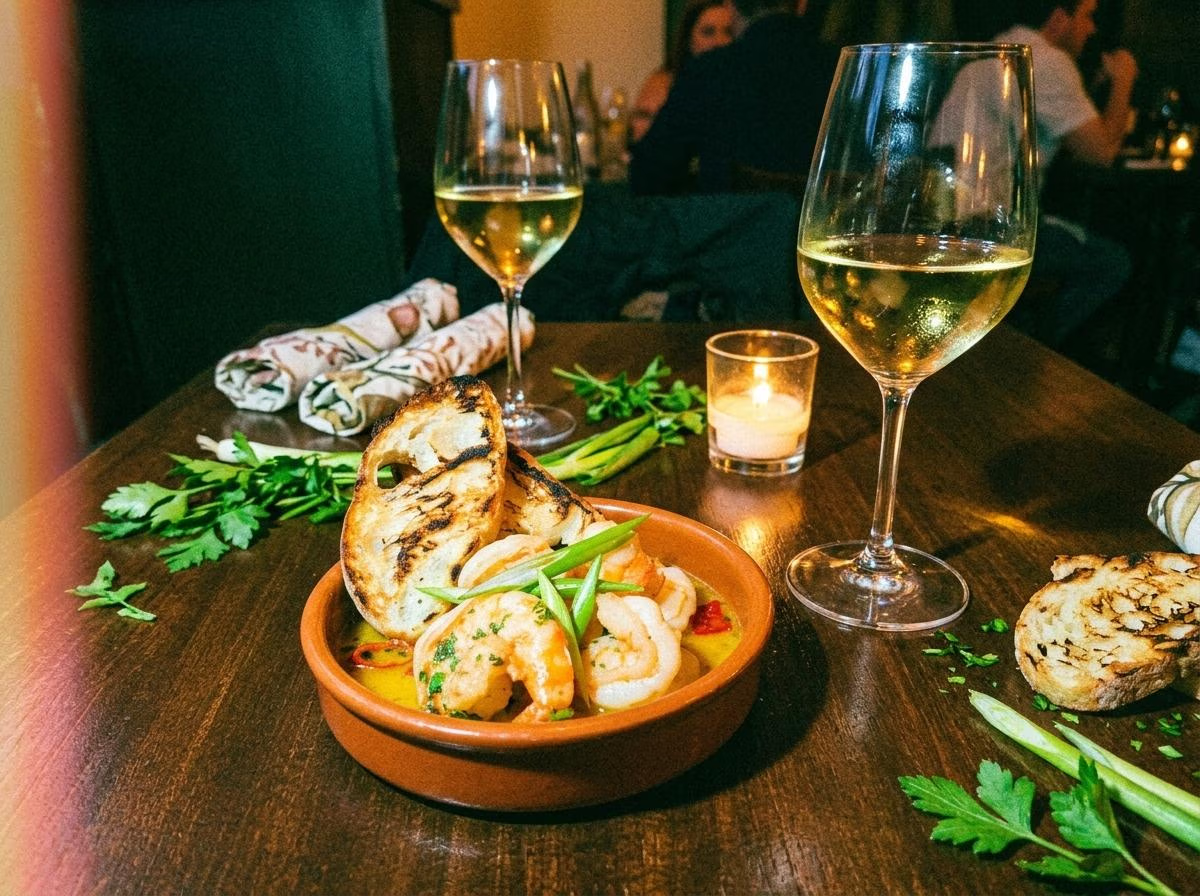
At Nia Restaurant & Wine Bar in Chicago’s West Loop, the current menu provides several useful examples. The shrimp paella is currently finished with extra-virgin olive oil and lemon, while the gambas al ajillo uses garlic-infused olive oil with shrimp, Spanish chili, and white wine.
Those two dishes demonstrate something important.
Olive oil does not perform only one job.
In one dish, it can finish and connect flavors.
In another, it becomes the medium through which garlic and chili reach the seafood.
That versatility is the real reason this ingredient deserves its own guide.

Olive Oil Is an Ingredient, Not Just a Cooking Fat
It is easy to think of oil as something neutral whose only purpose is to stop food from sticking to the pan.
Extra-virgin olive oil can be very different.
It may have recognizable aroma, bitterness, fruitiness, pungency, and other sensory characteristics.
The International Olive Council’s sensory standards identify fruitiness, bitterness, and pungency among the positive characteristics used in assessing virgin olive oil, with flavor intensity varying according to olive variety, origin, climate, and production.
That means changing olive oil can change a dish even if every other ingredient remains the same.
A delicate oil may sit quietly behind vegetables or seafood.
A more assertive oil may taste:
- grassy;
- peppery;
- bitter;
- green;
- ripe-fruit-like;
- or more intensely aromatic.
That does not mean the strongest oil is automatically the best.
The right oil depends on what the cook wants it to do.
Why Olive Trees Became So Important Around the Mediterranean
The olive tree is particularly well suited to many Mediterranean environments.
Its cultivation became intertwined with agriculture, trade, food production, and cultural life across the region over very long periods.
The International Olive Council traces olive cultivation through ancient Mediterranean civilizations and documents its spread through areas including Greek islands, mainland Greece, North Africa, Sicily, southern Italy, and the western Mediterranean.
Olive oil therefore became much more than a restaurant ingredient.
Historically it could be connected with:
- food;
- trade;
- agriculture;
- lighting;
- cosmetics;
- ritual;
- and economic activity.
Modern restaurant diners mostly encounter the culinary side.
But the agricultural history helps explain why olive oil carries such strong cultural associations.
Olive Oil Does Not Represent Every Mediterranean Cuisine Equally
This nuance is missing from much restaurant content.
Olive oil is undeniably central to many traditions.
But Mediterranean food is not one standardized cuisine.
Butter, animal fats, dairy, sesame-based fats, nuts, and other ingredients can also play important roles depending on region and dish.
A Greek vegetable preparation may use olive oil very differently from a Spanish fried dish.
A southern Italian tomato sauce and a Lebanese hummus preparation may both use olive oil while belonging to completely different culinary traditions.
A North African dish may combine olive oil with spices that would be unusual in another part of the Mediterranean.
Cultural accuracy therefore requires two ideas to exist at once:
Olive oil is enormously important across the Mediterranean.
And:
Mediterranean cuisines are still distinct from one another.
What Is Extra-Virgin Olive Oil?
The term extra virgin has a specific meaning.
It is not simply a marketing phrase for expensive oil.
The International Olive Council classifies virgin olive oils as oils obtained from olives using mechanical or other physical processes without refining treatments beyond processes such as washing, decantation, centrifugation, and filtration.
Within that category, extra-virgin olive oil must also meet defined chemical and sensory standards.
For diners and home cooks, the most useful point is simpler:
Extra-virgin olive oil is an unrefined virgin olive oil whose quality must satisfy both chemical and sensory requirements.
Its flavor therefore matters.
Extra-Virgin Olive Oil vs Virgin Olive Oil
Both are virgin oils produced through mechanical or physical processes rather than refining.
The difference lies in their quality classification.
The IOC defines extra-virgin olive oil according to stricter chemical and sensory criteria than virgin olive oil.
For the average home cook, that means extra virgin is often especially useful when you want the oil’s flavor to remain noticeable.
Examples include:
- finishing vegetables;
- dressing tomato;
- drizzling over beans;
- serving with bread;
- finishing seafood;
- or building a vinaigrette.
But extra virgin is not restricted to raw use.
That is an important myth to correct.
What Does a Bottle Labeled Simply “Olive Oil” Mean?
Under International Olive Council definitions, the category labeled olive oil can refer to a blend of refined olive oil and virgin olive oils that are fit for consumption.
That is different from extra virgin.
Refining generally creates a more neutral product, while the virgin portion contributes some flavor and other characteristics.
For cooking, this can be useful when the cook wants olive oil’s functional properties without a strong olive flavor.
The right choice depends on the dish.
Extra Virgin Does Not Mean “Use Only for Salad”
One of the most persistent myths is that extra-virgin olive oil should never be heated.
That is too simplistic.
The International Olive Council specifically discusses olive oil as a cooking and frying oil and notes that olive oil can remain suitable for heated cooking when used at appropriate temperatures rather than being overheated.
The better culinary question is:
Do you want the flavor of this particular oil in the finished dish?
For a tomato salad, the answer may obviously be yes.
For garlic shrimp, probably yes.
For deeply flavored frying where the oil’s subtler aroma becomes less important, a cook may choose a different olive-oil style according to cost and purpose.
Heat is one consideration.
Flavor and economics matter too.
Olive Oil for Sautéing
Sautéing is one of the easiest uses.
Olive oil can carry:
- garlic;
- onion;
- chili;
- herbs;
- and spices
through the pan.
When garlic is heated in oil, aromatic compounds spread through that oil.
The oil then coats the other ingredients.
This is why garlic-infused olive oil works so naturally with shrimp.
Nia’s current gambas al ajillo provides a direct example: shrimp is sautéed in garlic-infused olive oil with Spanish chili and white wine.
The oil is not an invisible background ingredient.
It is part of the sauce.
Olive Oil for Roasting
Vegetables respond particularly well to olive oil because the oil helps coat their surface while heat encourages browning.
Cauliflower.
Peppers.
Eggplant.
Tomato.
Zucchini.
Onions.
Potatoes.
Mushrooms.
The exact result depends on temperature and vegetable.
The useful principle is that olive oil can help dry heat create a richer exterior while carrying herbs or spices across the ingredient.
This is very different from using olive oil as a raw finishing oil.
Same ingredient.
Different culinary job.
Olive Oil for Grilling
Oil can also help prepare vegetables, seafood, bread, or meat for grilling.
A light coating may:
- carry seasoning;
- help surface browning;
- or reduce sticking depending on the ingredient and grill setup.
After grilling, a fresher extra-virgin olive oil may be added separately as a finishing component.
That two-stage use is common in cooking:
one oil supports the heat;
another application contributes fresh aroma at the end.
Olive Oil for Seafood
Olive oil and seafood work together for several reasons.
Lean seafood can benefit from added richness.
Garlic and chili dissolve and disperse effectively in oil.
Lemon or other acidity can then cut through that richness.
Herbs add aroma.
The combination becomes:
fat + acid + aromatic ingredient + seafood.
That formula appears throughout many Mediterranean preparations even though the exact regional recipes differ.
Nia’s current seafood menu illustrates two different versions.
Its shrimp paella is finished with extra-virgin olive oil and lemon.
Its gambas al ajillo uses garlic-infused olive oil as a cooking and sauce component.
The detailed seafood technique belongs on Nia’s Mediterranean Seafood Guide.
This page should own the role olive oil plays within those preparations.
Olive Oil With Tomato
Tomato and olive oil form one of the most recognizable Mediterranean combinations.
Tomato brings:
- acidity;
- sweetness;
- water;
- and savory flavor.
Olive oil brings:
- fat;
- body;
- aroma;
- and a smoother mouthfeel.
Together, they create balance.
Add garlic, basil, oregano, bread, cheese, peppers, or seafood and the combination moves into many different regional directions.
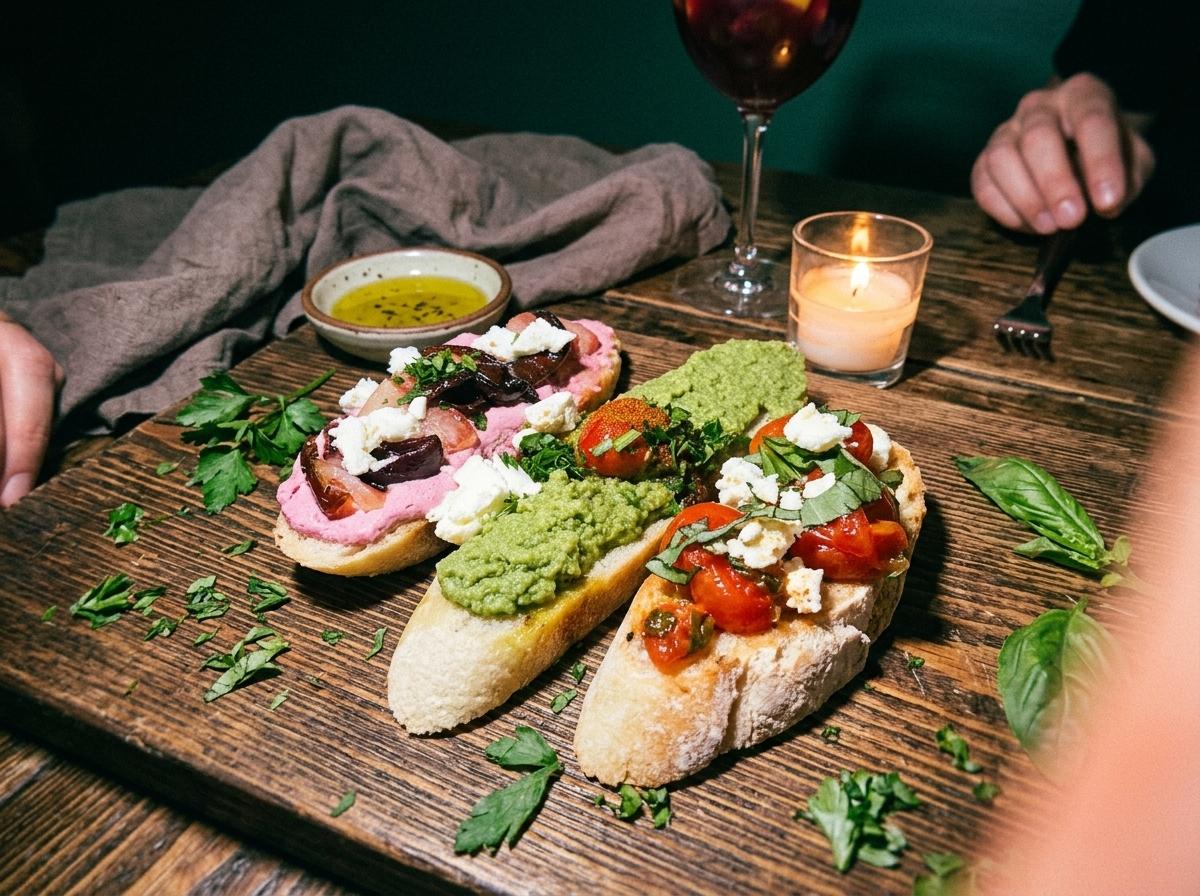
Nia currently uses tomato in its pan-con-tomate-inspired crostini, salmon pipérade, patatas bravas, and pizza preparations.
This olive-oil article should not repeat the complete ingredient encyclopedia.
Its task is to explain why tomato and oil interact so effectively.
Olive Oil With Citrus
Lemon is another important partner.
Oil brings richness.
Lemon brings acidity.
The combination is particularly useful with:
- seafood;
- vegetables;
- beans;
- salads;
- and grains.
Nia’s current shrimp paella is explicitly finished with both extra-virgin olive oil and lemon.
That is a simple example of balance.
Neither ingredient needs to dominate.
Olive Oil With Herbs
Herbs contain aromatic compounds that can interact well with fat.
Olive oil therefore works naturally with:
- basil;
- parsley;
- rosemary;
- oregano;
- thyme;
- mint;
- and other herbs depending on cuisine.
The oil can help distribute herb flavor across a dish.
A herb-and-oil mixture can become:
- a marinade;
- a dressing;
- a finishing sauce;
- or one component of a cooked preparation.
Again, regional specificity matters.
Not every Mediterranean cuisine uses the same herb mixture.
Olive Oil With Legumes
Chickpeas, beans, and lentils can benefit from olive oil because legumes are relatively mild and absorb surrounding flavors well.
Oil can add body to:
- hummus;
- bean salads;
- lentil dishes;
- soups;
- and spreads.
Add lemon.
Garlic.
Herbs.
Tomato.
Tahini.
Vegetables.
The same basic legume can become an entirely different dish.
Nia’s Mediterranean Ingredient Guide should own the complete legumes discussion.
Here, the key point is that olive oil can turn a lean, starchy ingredient into something richer and more aromatic.
Olive Oil in Hummus and Mezze
Olive oil frequently appears around hummus, eggplant dips, vegetables, beans, olives, and other dishes found in mezze traditions.
But the current Nia olive-oil article overstates this by treating Mediterranean small plates and mezze as essentially interchangeable across the whole region.
That should be corrected.
Mezze belongs particularly to Eastern Mediterranean, Middle Eastern, Greek, Turkish, Balkan, and related traditions.
Spanish tapas are different.
Olive oil appears in both.
That does not make them the same dining tradition.
The dedicated Mezze Guide should own the cultural explanation.
This page only needs to establish that olive oil appears across many different shared-dish traditions.
Olive Oil in Spanish Cooking
Spain is one of the places where olive oil has especially strong culinary importance.
It can appear in:
- pan con tomate;
- gambas al ajillo;
- vegetable dishes;
- fish;
- fried foods;
- dressings;
- rice dishes;
- and countless sauces and preparations.
That is particularly relevant to Nia because the restaurant describes its broader concept as Mediterranean-inspired with Spanish roots.
The current shrimp paella and gambas al ajillo provide the clearest live olive-oil examples.
The page should use these examples rather than generic claims that every Nia dish is built around olive oil.
Olive Oil and Frying
Mediterranean food is sometimes inaccurately described as though everything is lightly grilled or raw.
Frying is also part of Mediterranean culinary traditions.
The International Olive Council explicitly discusses olive oil’s use for frying and its performance at normal frying temperatures.
This matters because it corrects another stereotype:
Mediterranean cuisine is not simply salad, grilled fish, and raw olive oil.
Croquettes, potatoes, small fish, vegetables, pastries, and other fried foods appear in different Mediterranean cuisines.
The presence of frying does not make a dish “non-Mediterranean.”
Olive Oil in Baking
Olive oil can also be used in baking.
In savory applications, it may appear in:
- bread;
- flatbreads;
- vegetable pastries;
- or doughs.
In sweets, olive oil can sometimes replace or complement other fats while giving the dessert a distinct flavor.
Whether that flavor is desirable depends on the recipe and oil.
A strongly peppery extra-virgin oil may be excellent in one cake and distracting in another.
Cooking with olive oil is not about using the same bottle for everything automatically.
It is about matching the oil to the preparation.
Olive Oil as a Finishing Ingredient
Finishing is one of the clearest places where olive oil’s flavor matters.
A small amount added immediately before service may contribute:
- fresh aroma;
- fruitiness;
- bitterness;
- peppery sensation;
- shine;
- and richness.
The oil has undergone less heat, so more of its sensory identity remains obvious.
This is why the International Olive Council notes that virgin olive oils can be especially appreciated raw when their aroma and flavor remain fully evident.
Finishing oil should therefore be treated almost like seasoning.
More is not always better.
The goal is enough to influence the dish without making it greasy.

Why Some Olive Oil Tastes Peppery
Peppery or pungent sensation is not automatically a defect.
The International Olive Council recognizes pungency as one of the positive sensory attributes used when assessing virgin olive oils.
Likewise, bitterness can be a positive characteristic.
This can surprise people who expect “good olive oil” to taste completely soft and neutral.
Different oils serve different preferences and foods.
A bitter, pungent oil may work beautifully with:
- beans;
- grilled bread;
- tomatoes;
- or robust vegetables.
A more delicate oil may make more sense with:
- mild fish;
- soft cheese;
- or subtle salads.
Does Olive Oil Color Tell You Its Quality?
Color is less useful than many consumers assume.
Olive oils can range from greener tones to golden shades depending on factors such as olive variety and ripeness.
The more useful evaluation involves aroma, flavor, freshness, classification, and proper storage.
Do not choose an olive oil only because it is extremely green.
And do not assume a golden oil is lower quality simply because its color is lighter.
How to Taste Extra-Virgin Olive Oil
You do not need to be a professional sensory-panel member to notice differences.
Pour a small amount.
Smell it.
Taste a little.
Notice:
- fruitiness;
- bitterness;
- pungency;
- fresh green aromas;
Olive Oil Is Sensitive to Light, Heat, and Air
A good oil can decline after poor storage.
The International Olive Council recommends protecting olive oil from excessive light, heat, and air exposure.
For a home kitchen, that means olive oil generally should not live:
- beside a very hot stove;
- on a sunny windowsill;
- or in an open container for long periods.
A closed bottle stored in a cool, dark location is a better choice.
This is one of the most practical sections the current Nia article is missing.
Bigger Bottles Are Not Always Better
Buying olive oil in bulk may seem economical.
It only makes sense if you will use it while its sensory quality remains good.
For a household that rarely cooks with olive oil, a smaller bottle may deliver a better experience because the oil spends less time opened and exposed to oxygen.
For someone who uses olive oil every day, a larger container may be reasonable.
Purchase size should match actual usage.
Dark Packaging Can Help Protect the Oil
Because light can degrade olive oil quality, packaging that reduces exposure can be useful.
The International Olive Council’s storage recommendations emphasize protecting olive oil from direct and excessive light during storage and sale.
That does not mean every transparent bottle contains bad oil.
It means storage conditions matter.
A beautiful bottle left in strong sunlight is not being treated well.
Should Olive Oil Be Refrigerated?
For most normal kitchen use, the more important principles are:
- avoid excessive heat;
- avoid direct light;
- keep the bottle closed;
- and store it in a reasonably cool place.
Refrigeration can cause olive oil to become cloudy or partially solid because different components crystallize at lower temperatures.
That usually reverses when the oil warms.
For ordinary households, a dark cupboard away from a hot stove is often more practical.
Does Extra-Virgin Olive Oil Have a Smoke Point?
Yes.
But smoke point should not become the only factor used to judge an oil’s suitability.
Cooking stability depends on multiple characteristics.
The International Olive Council notes that olive oil can tolerate typical frying temperatures when not overheated and reports a smoke point around 210°C for olive oil in its culinary guidance.
The safer practical rule is:
Do not deliberately burn the oil.
If the pan is smoking aggressively before the food goes in, the heat is too high for the technique being attempted.
Is Olive Oil “Healthier” Than Butter?
This question belongs primarily on Nia’s dedicated Mediterranean Diet Health Guide, but a short evidence-based answer is appropriate here.
The American Heart Association recommends replacing fats higher in saturated fat with unsaturated plant oils and includes olive oil among the cooking oils that provide more monounsaturated and polyunsaturated fats.
The Mediterranean-style eating pattern described by the AHA also uses olive oil as a primary fat source.
The responsible wording is:
Olive oil can be a useful source of unsaturated fat within an overall balanced eating pattern, particularly when it replaces fats higher in saturated fat.
Olive Oil at Nia Today
The current live menu provides two especially clear olive-oil examples.
Shrimp Paella
Nia currently lists shrimp paella with saffron rice, shrimp, peas, peppers, parsley, extra-virgin olive oil, and lemon.
Here olive oil appears as a finishing element within a rice-and-seafood preparation.
The lemon gives contrast.
The herbs add freshness.
The oil contributes richness and helps connect the components.
Gambas al Ajillo
Nia currently serves shrimp sautéed in garlic-infused olive oil with Spanish chili and white wine, accompanied by crusty bread.
Here olive oil performs a much larger role.
It carries garlic and chili.
It interacts with shrimp juices and wine.
And the bread gives diners a way to eat the flavored oil remaining in the dish.
One ingredient.
Two entirely different functions.
Marinated Olives
Nia also currently lists marinated Mediterranean olives.
The relationship between table olives and olive oil is worth understanding.
They come from the same fruit, but they are different foods.
Whole olives provide:
- texture;
- water;
- fiber;
- salinity from curing;
- and the flesh of the fruit.
Olive oil is concentrated fat extracted from olives.
They should not be treated as nutritionally or culinarily interchangeable.

How to Choose Olive Oil for Home Cooking
You do not need the most expensive bottle in the store.
Start with how you plan to use it.
For Finishing
Choose an extra-virgin olive oil whose flavor you genuinely enjoy.
Taste matters because the oil will remain obvious.
For Salad Dressing
Look for enough character to survive vinegar, citrus, mustard, tomato, cheese, or herbs.
For Seafood
A delicate-to-medium oil can be useful when you want the fish or shellfish to remain dominant.
A more assertive oil can work with garlic, tomato, chili, or grilled preparations.
For Roasting
Choose an olive oil that fits both your budget and desired flavor because roasting may require more oil than finishing.
For Bread
Flavor is the point.
This is where fruitiness, bitterness, and pungency become especially easy to notice.
The important rule is:
Choose by culinary purpose, not simply by price or marketing language.
How Much Olive Oil Should You Use?
Enough to achieve the cooking result.
That sounds simple because it is.
For salad dressing, you need enough to coat.
For roasting, enough to cover the vegetables lightly.
For sautéing, enough to conduct heat and carry aromatics.
For finishing, sometimes a teaspoon or small drizzle is sufficient.
This page is about cooking, not medical dosing.
Can Olive Oil Go Bad?
Its sensory quality can deteriorate.
Light.
Heat.
Oxygen.
Time.
These can all reduce the fresh characteristics that made the oil appealing.
The IOC specifically recommends limiting exposure to heat, air, and light.
If oil smells or tastes stale, waxy, or otherwise unpleasant, replacing it may improve the food dramatically.
A good tomato cannot rescue rancid oil.
Should You Buy the Most Expensive Olive Oil?
No.
Price can reflect:
- production cost;
- brand;
- origin;
- bottle design;
- import expenses;
- quality;
- scarcity;
- or marketing.
The best value depends on use.
A relatively expensive, highly aromatic extra-virgin oil may make sense for finishing a simple dish.
Using that same bottle by the cup for every cooking task may not make financial sense.
Many kitchens keep more than one oil for exactly this reason.
Is “Cold-Pressed” the Same as Extra Virgin?
Not exactly.
Extra virgin is a formal quality category based on production and quality requirements.
Marketing phrases such as cold-pressed do not replace that classification.
A shopper primarily looking for extra-virgin olive oil should check whether the bottle is actually labeled extra virgin, not simply rely on attractive extraction language.
Is Unfiltered Olive Oil Better?
Not automatically.
Filtered and unfiltered oils can both be high quality.
Unfiltered oil may have a different appearance and mouthfeel because small amounts of olive material or moisture remain.
Those particles can also affect stability.
The choice is partly stylistic.
“Cloudy” should not automatically be interpreted as more natural, authentic, or superior.
Does Olive Oil Improve Every Dish?
No.
Sometimes butter is the right culinary choice.
Sometimes sesame oil.
Sometimes another neutral plant oil.
Sometimes rendered animal fat.
Cuisine should not become ideology.
Even the American Heart Association’s discussion of cooking oils acknowledges several liquid plant oils as reasonable choices rather than treating olive oil as the only acceptable oil.
Olive oil is central to Mediterranean cooking because of history, flavor, agriculture, and versatility—not because every other fat is invalid.
Frequently Asked Questions About Olive Oil in Mediterranean Cooking
Why is olive oil so important in Mediterranean cuisine?
Olive oil has a long agricultural and culinary history across many Mediterranean regions and can perform numerous roles: cooking, sautéing, roasting, dressing, marinating, finishing, frying, and carrying herbs, garlic, spices, and other flavors.
Its cultural importance developed alongside centuries of olive cultivation around the Mediterranean basin.
Is olive oil used in every Mediterranean dish?
No.
Mediterranean cuisine includes many regions, cooking fats, and traditions.
Olive oil is one of the region’s most important recurring ingredients, not a mandatory component of every dish.
What is extra-virgin olive oil?
Extra-virgin olive oil is a category of virgin olive oil obtained through mechanical or physical processes and required to meet defined chemical and sensory standards.
What is the difference between extra-virgin and regular olive oil?
Extra virgin is an unrefined virgin olive oil that meets stricter quality and sensory criteria.
Under IOC definitions, olive oil labeled simply “olive oil” can refer to a blend of refined olive oil and virgin olive oils.
Can you cook with extra-virgin olive oil?
Yes.
Extra-virgin and other olive oils can be used for cooking.
The idea that EVOO should never be heated is too simplistic.
Avoid overheating or deliberately burning any cooking oil.
Can you fry with olive oil?
Yes.
The International Olive Council specifically recognizes olive oil as suitable for frying when used at appropriate temperatures.
Why does some olive oil taste bitter?
Bitterness can be a positive characteristic of virgin olive oil rather than a flaw.
The IOC includes bitterness among the sensory attributes used to characterize olive oils.
Why does olive oil sometimes make your throat feel peppery?
That pungent sensation can also be a positive sensory attribute.
The IOC evaluates pungency alongside fruitiness and bitterness.
Is greener olive oil better?
Not necessarily.
Color alone does not establish olive-oil quality.
Flavor, aroma, freshness, classification, production, and storage provide more useful information.
Should olive oil be stored beside the stove?
Preferably not if that location becomes hot.
The IOC recommends protecting olive oil from heat, light, and air exposure.
Should olive oil be stored in a dark bottle?
Packaging that limits light exposure can help protect the oil.
Regardless of bottle color, keep olive oil away from direct sunlight.
Is olive oil healthy?
Olive oil is a source of unsaturated fat and is used as a primary fat source in Mediterranean-style dietary patterns.
The American Heart Association recommends replacing sources of saturated fat with unsaturated plant oils such as olive oil within an overall healthy dietary pattern.
That does not mean unlimited olive oil produces unlimited health benefits.
Is extra-virgin olive oil better for health than other olive oils?
This article should not turn that question into personalized medical advice.
Extra-virgin olive oil is less refined and retains its characteristic sensory compounds, while dietary outcomes depend on amount, substitution, and the person’s overall eating pattern.
For deeper health evidence, use Nia’s dedicated Mediterranean Diet Health Guide.
Does olive oil reduce cholesterol?
Health effects should be discussed in terms of overall dietary patterns and what fats olive oil replaces rather than promising that one ingredient will lower an individual’s cholesterol.
The AHA recommends replacing saturated fats with unsaturated fats, including olive oil as one possible plant-oil choice.
Does olive oil reduce inflammation?
Do not market a restaurant dish as anti-inflammatory merely because it contains olive oil.
Research on dietary patterns and olive oil belongs on the evidence-led health page.
Why does olive oil work with seafood?
It provides richness and acts as a carrier for ingredients such as garlic, chili, herbs, and citrus.
Nia’s current gambas al ajillo demonstrates this directly through garlic-infused olive oil with shrimp, chili, and white wine.
What Nia dishes currently use olive oil?
The current dinner menu explicitly lists extra-virgin olive oil in the shrimp paella and garlic-infused olive oil in gambas al ajillo.
Menu descriptions can change, so the live Dinner Menu should remain the authority.
Does Nia currently serve bread with olive oil from family groves in Greece?
An older indexed version of Nia’s menu described extra-virgin olive oil from family olive groves in Akova, Greece, but that language is absent from the current live menu reviewed for this audit.
Nia should confirm current sourcing before this article presents the Akova story as a live operational fact.